
The only land crossing between the UAE and Saudi Arabia — and the first border on four of our five GCC routes.
- 24/7 operating
- 2–4 hr clean clearance
- Primary UAE–KSA crossing
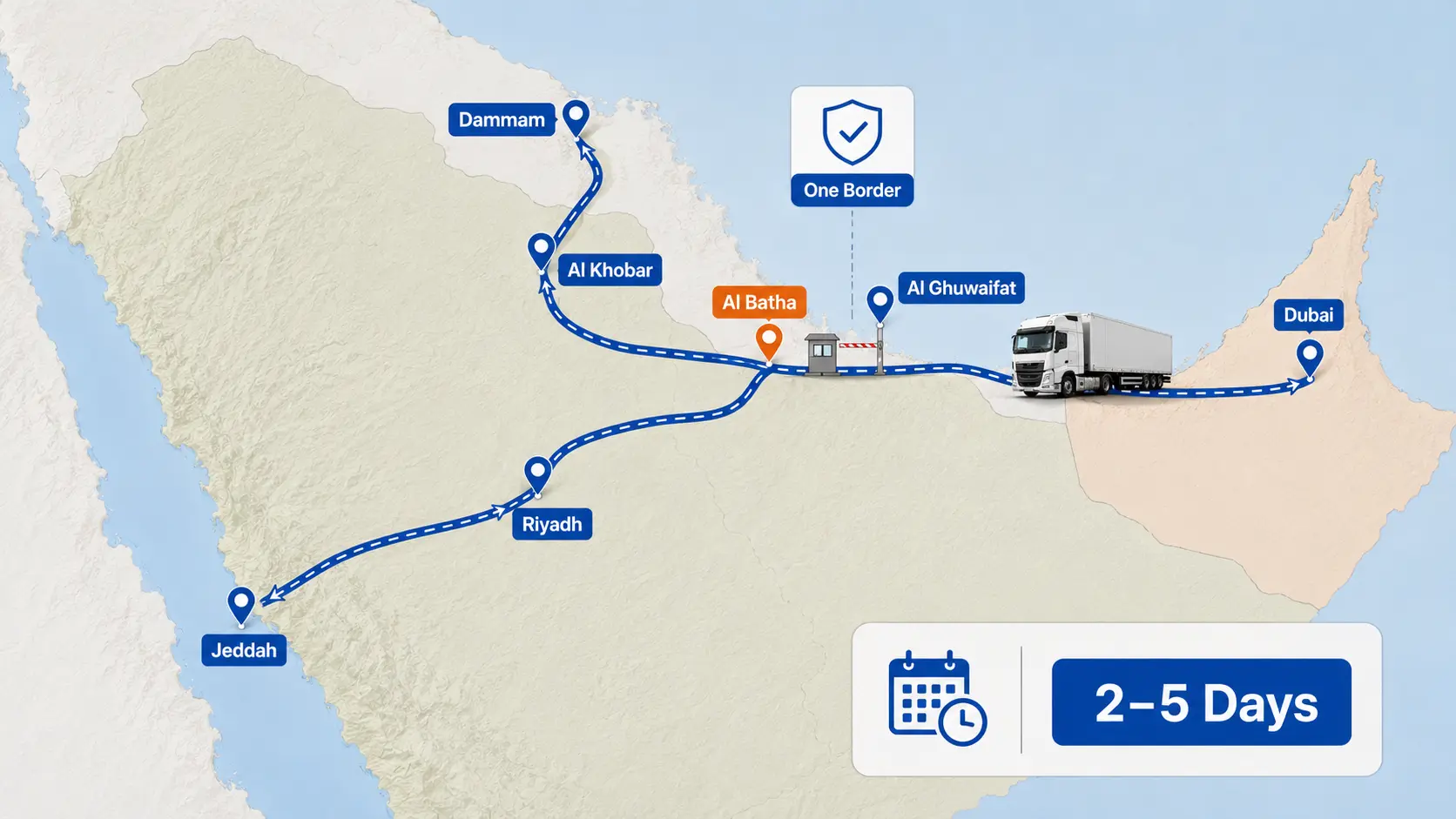
Al Ghuwaifat (UAE side) and Al Batha (Saudi side) is the only land crossing between the United Arab Emirates and Saudi Arabia. It’s the border every one of our routes uses except pure Dubai–Oman shipments — including cargo bound for Qatar, Kuwait, and Bahrain, which all transit through here first before reaching a second border.
Quick Facts
- Distance from Dubai: ~460–480 km
- Driving time: ~5–6 hours
- Operating hours: 24/7
- Typical cargo clearance: 2–4 hours with clean documentation
Where This Border Actually Is
Al Ghuwaifat sits on the western edge of Abu Dhabi emirate, on the E11 highway, and is the primary commercial freight crossing between the UAE and Saudi Arabia — it handles the highest volume of trucks of any UAE–KSA crossing. On the Saudi side, the corresponding post is Al Batha, connecting onward via Saudi Highway 95 toward Riyadh, Dammam, and the Eastern Province, or further inland toward Jeddah.
There is a secondary option via the Hatta crossing on the Dubai–Oman border road, providing an alternative route into Saudi Arabia via Oman. It adds distance and is generally only used when Al Ghuwaifat is heavily congested. For the large majority of Dubai–Saudi Arabia road freight, Al Ghuwaifat/Al Batha is the standard crossing we use.
Which of Our Routes Use This Border
| Destination | Role of this border | What happens next |
|---|---|---|
| Saudi Arabia | Final entry border | Cargo clears Saudi customs here and continues to Riyadh, Jeddah, Dammam, or Al Khobar |
| Qatar | First of two borders | Cargo transits Saudi Arabia (~460km) to the Salwa border, then exits into Qatar at Abu Samra |
| Kuwait | First of two borders | Cargo transits Saudi Arabia (1,000+ km) to Al Khafji, then exits into Kuwait |
| Bahrain | First of two borders | Cargo transits Saudi Arabia (~120km) to the King Fahd Causeway, then crosses into Bahrain |
Only Dubai–Oman shipments avoid this crossing entirely, using the Hatta/Al Wajajah or Al Ain/Buraimi borders instead.
Documents Required for Commercial Cargo
Saudi Arabia’s import requirements are specific, and this is one of the more document-intensive crossings in the region for commercial freight. Get the paperwork wrong and your shipment sits at the border while your customer waits — this is the single most common and most preventable cause of delay we see.
- Commercial invoice — accurate value, description, and correct HS code for every line item
- Packing list — matching the invoice exactly in item count and weight
- GCC Certificate of Origin — required for UAE-origin goods to move duty-free under the GCC Customs Union; without it, standard 5% CIF duty applies
- Road manifest / bill of lading — covering the specific truck and driver making the crossing
- SABER/SASO registration — required for over 100 regulated product categories under Saudi’s product conformity program
- Transit declaration — for cargo continuing on to Qatar, Kuwait, or Bahrain, filed as bonded transit rather than a standard Saudi import
Where this actually goes wrong: the root cause of most delays here isn’t a missing document — it’s an inconsistency between documents. A packing list that doesn’t match the invoice line-for-line, or an HS code that doesn’t match the physical goods, is what triggers a hold or a full inspection. We check every shipment’s documentation for internal consistency before the truck leaves Dubai, not just for completeness.
Realistic Processing Times
- Clean, pre-checked documentation: commonly clears in 2 to 4 hours
- Missing or inconsistent documents, or cargo flagged for inspection: can extend to 24–72 hours or longer
- Peak periods (Ramadan, days around Eid al-Fitr and Eid al-Adha, public holidays): queues lengthen significantly and processing slows on the Saudi side in particular
- Time of arrival: trucks arriving during shift changes or peak traffic windows face longer queues than those timed for off-peak hours
Cargo Insurance on This Route
Given the distance and multiple handling points on a Dubai–Saudi Arabia road shipment, we offer cargo insurance covering transit loss and damage. Ask for it explicitly when requesting your quote — we disclose the coverage and cost upfront rather than bundling it invisibly into the price or leaving it out entirely.
Frequently Asked Questions
Which crossing is used for Dubai to Saudi Arabia road freight?
Al Ghuwaifat, on the UAE side, paired with Al Batha on the Saudi side. It’s the primary and highest-volume commercial freight crossing between the two countries.
How long does it take to cross Al Ghuwaifat/Al Batha?
With complete, consistent documentation, cargo commonly clears in 2 to 4 hours. Incomplete or inconsistent paperwork, or cargo that triggers inspection, can extend that to a day or more.
Is this the same border used for Qatar, Kuwait, and Bahrain shipments?
Yes. Since Qatar, Kuwait, and Bahrain have no direct land border with the UAE, cargo bound for all three transits Saudi Arabia first via Al Ghuwaifat/Al Batha before reaching a second, country-specific border further into Saudi territory.
What causes delays at this border?
Most commonly: inconsistencies between the commercial invoice and packing list, incorrect HS code declarations, missing SABER registration for regulated goods, and cargo selected for physical inspection. Border congestion during Ramadan, Eid, and public holidays also extends queue times significantly.
Is there an alternative route if this border is congested?
The Hatta crossing on the Dubai–Oman border road offers an alternative route into Saudi Arabia via Oman, generally with shorter queues, but it adds distance to most Saudi destinations and requires Oman transit documentation.