
Freight services Dubai shippers actually need come down to six clear options, not fifty vague ones. Knowing how to choose a reliable logistics provider in Dubai usually comes down to exactly this: matching the service to the cargo, not picking whoever answers the phone first. Most cargo problems on GCC roads don’t start with the truck — they start with the wrong service booked for the job. A shipment quoted as FTL when LTL would have done the work costs double for no reason. A pallet of dairy loaded into a standard trailer instead of a pre-cooled reefer is already compromised before it reaches a single border. Machinery booked on a trailer that can’t legally carry its weight sits at a Saudi weighing station instead of moving. None of that is about the road itself — it’s about matching the cargo to the right service before departure, not after something goes wrong.
Every one of these is door to door by default. Here are the six services we actually run, and the specific reason to pick each one.
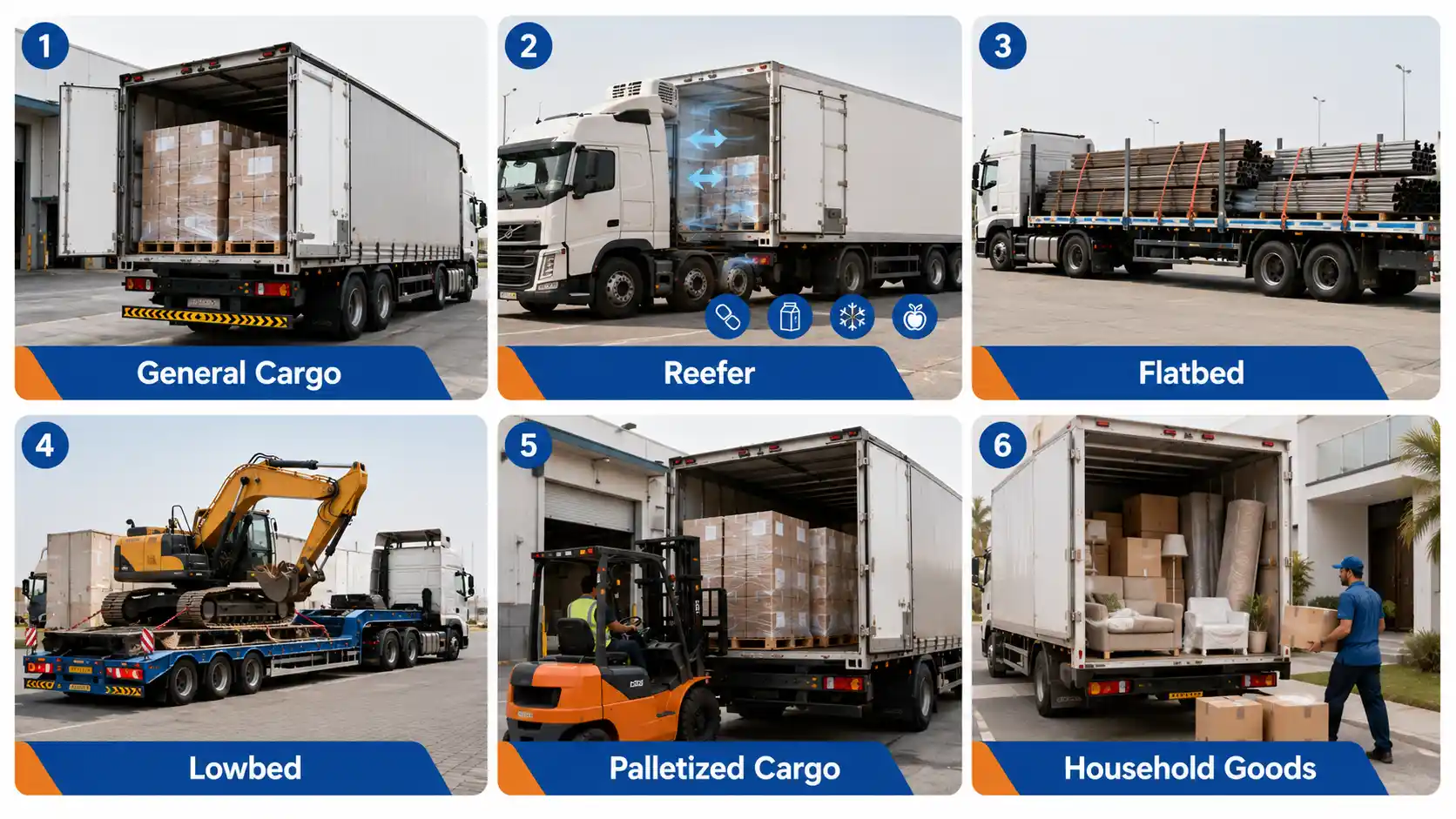
Full Truckload (FTL)
One truck, sealed at your pickup point in Dubai, opened only at delivery. Nobody else’s cargo shares the space. This is the right call when a shipment is time-critical, high-value, or simply too large to consolidate — and it’s the only option that gives you a fixed departure time rather than a scheduled window. Most of our Saudi Arabia and Kuwait shipments run FTL simply because of the distances involved.
Less-than-Truckload (LTL)
Your cargo shares a truck with other shippers’ consignments, consolidated on a scheduled departure rather than the moment you’re ready. It costs less per kilogram than FTL, and it’s the practical option if you’re not filling a full trailer. The trade-off is a short consolidation window before departure — we’ll tell you the actual cutoff for your route when you book, not a vague estimate.
Temperature-Controlled (Reefer) Trucking
Pharmaceuticals, dairy, frozen goods, produce — anything that can’t tolerate a Gulf summer. Ambient temperatures on the Dubai–Saudi corridor regularly pass 45–48°C between May and September, and a reefer trailer that’s only cooled after loading has already lost the battle. Ours are pre-cooled before your cargo goes in, and we monitor the load through every border stop, since that’s where a cold chain is most likely to slip.
Flatbed & Lowbed Transport
Machinery, construction equipment, and oversized loads that won’t fit inside a standard trailer. This is a steady part of our Saudi Arabia volume in particular, given how much project cargo is moving toward ongoing infrastructure and industrial builds there. Oversized loads sometimes need route permits on the Saudi side — we handle that as part of the booking, not as a separate scramble once the truck is already loaded.
Palletized General Cargo
Standard commercial goods, retail stock, and spare parts on pallets — the bulk of what actually moves on GCC roads day to day. This is usually LTL-compatible and runs on the most predictable schedules of anything we handle, which makes it the easiest cargo type to plan recurring shipments around.
Personal Effects & Household Relocation
Household goods for people relocating to Muscat, Doha, Kuwait City, or Manama by road. The paperwork is different from commercial cargo — personal registration checks in some destination countries, different customs treatment — but the border expertise behind it is the same we use for every other shipment.
Documentation and Customs Clearance
As one of the logistics companies in Dubai that handles customs clearance services in-house rather than outsourcing them, every shipment we run needs a commercial invoice, packing list, and Certificate of Origin that all agree with each other — inconsistency between those three documents is the single most common reason cargo gets held at a border, not a missing document. We check that consistency before your truck leaves Dubai. On the export side, that means clean manifest submission through Dubai Customs; on the destination side, it means the right paperwork for whichever border crossing your route uses.
Which Service Do You Need?
Cargo logistics Dubai businesses lean on us for exactly this kind of straight answer, not a sales pitch. If you’re not sure whether your shipment needs FTL or LTL, reefer or standard, tell us the cargo type, weight, and route and we’ll tell you honestly which option fits — see our five GCC routes or get a quote directly.