
Dubai-Based Road Cargo Specialists
Road Cargo in Dubai for GCC Deliveries
Khaleej Cargo is a Dubai logistics company specializing exclusively in road freight — full truckload and less-than-truckload — to five GCC destinations: Saudi Arabia, Qatar, Oman, Kuwait, and Bahrain. That’s the whole business. If your shipment is going by truck to one of these five countries, this is what we do every day.
Dubai → 5 GCC countries
FTL & LTL by road
Customs cleared before departure
Real border-crossing expertise
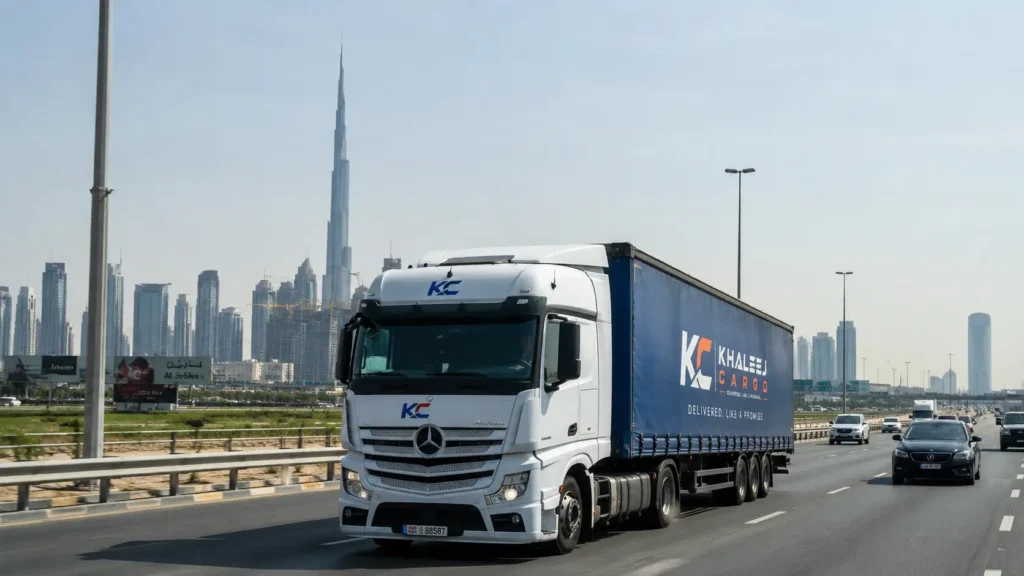
Dubai → GCC By Road
What most Dubai cargo companies won’t tell you
Two of these routes are direct — Saudi Arabia and Oman share a land border with the UAE. The other three don’t. Qatar, Kuwait, and Bahrain have no land border with the UAE at all — every truck we send to Doha, Kuwait City, or Manama crosses into Saudi Arabia first, transits Saudi territory, and clears a second border before reaching its destination. Most shipping companies in Dubai treat “GCC shipping” as one flat service and won’t tell you that. We think it’s the first thing you should know, because it’s the thing that actually determines your transit time, your documentation, and how many things can go wrong along the way.
Two direct routes. Three that cross two borders.
Direct: Saudi Arabia, Oman.
Via Saudi transit (two borders): Qatar, Kuwait, Bahrain.
Service Coverage
The Five Routes We Run
Every route below uses a real, named border crossing — not a vague “we handle GCC logistics” claim.
- Dubai → Saudi Arabia1 border · Al Ghuwaifat / Al Batha
- Dubai → Qatar2 borders · via Salwa / Abu Samra
- Dubai → Bahrain2 borders · King Fahd Causeway
- Dubai → Kuwait2 borders · via Al Khafji
- Dubai → Oman1 border · Hatta / Al Wajajah
Every Dubai–GCC route we run, and how many borders each one crosses.
🇸🇦 Dubai to Saudi Arabia
Border used: Al Ghuwaifat (UAE side) / Al Batha (Saudi side)
Typical transit: 2–5 days, depending on destination city and border processing. Riyadh and Dammam clear faster than Jeddah on the west coast.
We run FTL and LTL trucks to Riyadh, Jeddah, Dammam, and Al Khobar, with documentation prepared and submitted before the truck ever reaches the border.
🇶🇦 Dubai to Qatar
Route: Transit through Saudi Arabia via Al Ghuwaifat/Al Batha, then Salwa (Saudi side) into Abu Samra (Qatar side)
Typical transit: 1–3 days
This is a two-border shipment — your cargo clears Saudi Arabia and Qatar customs separately, under transit documentation. We handle both.
🇴🇲 Dubai to Oman
Border used: Hatta / Al Wajajah (Dubai side, direct) or Al Ain / Buraimi (Abu Dhabi side, alternative)
Typical transit: 1–2 days to Muscat and Sohar; up to 3–4 days to Salalah in the south
Oman is the only one of our five routes with a genuinely short, direct crossing — no transit country involved.
🇰🇼 Dubai to Kuwait
Route: Transit through Saudi Arabia via Al Ghuwaifat/Al Batha, then Al Khafji into Kuwait
Typical transit: 3–5 days
The longest of our five routes by distance — well over 1,000km of Saudi transit before the second border. We build realistic timelines around that, not optimistic ones.
🇧🇭 Dubai to Bahrain
Route: Transit through Saudi Arabia via Al Ghuwaifat/Al Batha, then the King Fahd Causeway into Bahrain
Typical transit: 1–3 days for standard commercial cargo
The King Fahd Causeway is a 25km bridge over open water — the only physical link between Saudi Arabia and Bahrain, and the final leg of every Dubai-to-Bahrain road shipment.
Our Services
What We Actually Move
From a single pallet to a full reefer load — the cargo types we handle on the Dubai–GCC road corridor every day.
Full Truckload (FTL)
A dedicated truck, sealed at pickup in Dubai and opened only at delivery. Best for full pallet runs, time-critical loads, and anything you don’t want handled more than once.
Less-than-Truckload (LTL)
Shared truck space for smaller consignments, consolidated on scheduled departures. The cost-effective option when you don’t need a full truck.
Temperature-Controlled (Reefer)
For pharmaceuticals, dairy, frozen goods, and produce. Dubai summer ambient temperatures regularly pass 45°C, and every degree of exposure matters for a cold chain. Our reefer trucks are pre-cooled before loading, not after.
Flatbed & Lowbed Transport
For machinery, construction equipment, and oversized loads headed to project sites in Saudi Arabia, Qatar, and Oman.
Palletized General Cargo
Retail stock, FMCG, spare parts, and standard commercial goods.
Personal Effects & Household Goods
For people relocating to Riyadh, Doha, Muscat, Kuwait City, or Manama by road. Different documentation, different concerns, same border expertise.
How It Works
How a Shipment With Us Actually Works
Six clear steps, from your first message to a signed proof of delivery.
01
You send us the details.
Origin, destination, weight, dimensions, and commodity type. We tell you straight away whether it’s FTL or LTL territory, and give you a realistic timeline for that specific border — not a generic one.
02
We prepare documentation before the truck leaves Dubai.
Commercial invoice, packing list, and Certificate of Origin are checked and submitted ahead of departure. Most border delays come from paperwork problems discovered at the crossing — we catch those in Dubai, not at Al Batha.
03
Pickup from your location.
We collect from Al Quoz, Ras Al Khor, Jebel Ali, Al Qusais, Dubai Investment Park, Dubai South, Deira, or anywhere else in Dubai.
04
Border crossing.
For Saudi Arabia and Oman, that’s one crossing. For Qatar, Kuwait, and Bahrain, your cargo clears two customs authorities under transit documentation. We tell you which borders your shipment will cross before you book, not after.
05
You get visibility, not silence.
Real-time tracking and a border-crossing update, so you’re not calling in blind to ask where your truck is.
06
Delivery and proof of delivery.
Signed, timestamped, sent to you.
Real Experience
Built for the Roads We Actually Drive
As a road transport and logistics company in Dubai, we’re based here and run these five routes daily — not as a side service alongside air and sea freight, but as the whole business.
Where we collect from
Al Quoz, Ras Al Khor, Al Qusais, Jebel Ali, Dubai Investment Park, Dubai South, and Deira are our most common pickup zones — the industrial and trading areas where most of our shippers are based. Wherever your business is registered, from a Makani number in an industrial warehouse to a trading office on Sheikh Zayed Road, we know how to find it. Dubai doesn’t use street-level postal codes the way many countries do — deliveries here run on the UAE’s Makani unique-address system, and our drivers work with it every day.
What the desert route actually involves
The drive from Dubai into Saudi Arabia and onward runs through genuine desert terrain — long, straight highway stretches where the real hazards are heat, fatigue, and the occasional stray camel on the road, particularly after dark. Summer temperatures along these corridors regularly exceed 45–48°C, which is exactly why our reefer trucks are built around pre-cooling and minimal dock exposure, not an afterthought bolted onto a dry-van service.
What the calendar does to transit times
Ramadan and the days around Eid al-Fitr and Eid al-Adha bring real, predictable disruption — customs offices reduce hours, border volumes spike, and crossings that normally take a few hours can stretch into days. We build our departure schedules around this every year instead of pretending it doesn’t happen.
Who We Serve
Industries We Move Freight For
The businesses and people who rely on the Dubai–GCC road corridor — and what we move for each.
Trading & Re-Export Businesses
Dubai’s core economy, moving imported goods on to GCC markets by truck. See the documentation checklist →
Construction & Industrial
Machinery, materials, and spare parts to project sites across Saudi Arabia, Qatar, and Oman. See Flatbed & Lowbed →
Retail & FMCG
Stock replenishment on predictable, recurring schedules. See Palletized Cargo →
Pharmaceuticals & F&B
Cold chain cargo where a broken temperature record isn’t an inconvenience, it’s a write-off. See Reefer Trucking →
Individuals & Families Relocating
Household goods moving by road to a new home in the GCC. See Personal Effects & Relocation →
Why Choose Us
Why Shippers Work With Us
The road freight industry in the GCC has a real trust problem — long, unexplained delays, no visibility once a truck crosses a border, and vague answers when something goes wrong. We built this business around fixing that, not talking around it.
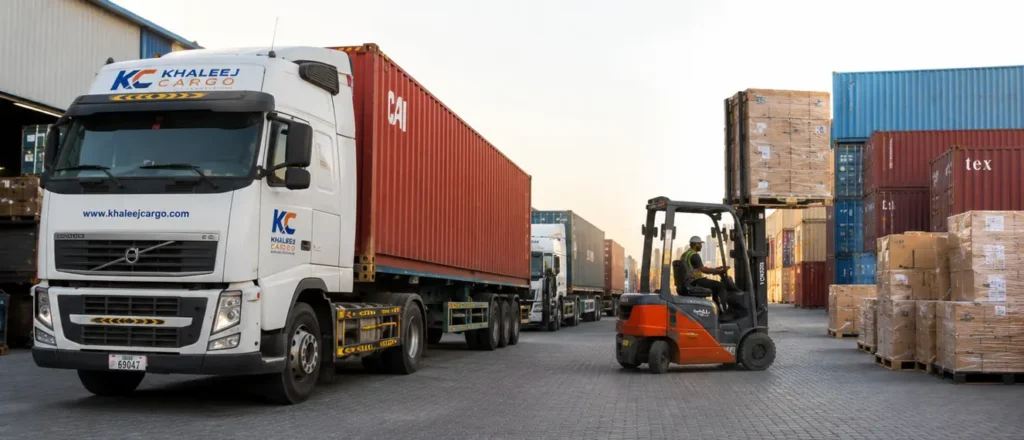
We tell you the honest transit range, not the best-case number.
“2–5 days” for Saudi Arabia isn’t hedging — it’s the real range depending on which border queue your truck lands in.
Documentation is prepared before departure, not at the border.
That’s where most delays actually start.
You get a direct point of contact, not a call center reading from a script.
A real person who knows your shipment and these five routes.
No surprise charges.
Demurrage, waiting time, and any additional fees are explained upfront, in writing, before you book — not discovered on the final invoice.
We know these five countries because we only run these five countries.
Saudi Arabia, Qatar, Oman, Kuwait, and Bahrain — by road, from Dubai. That’s the whole business.
What We Handle For You
The Paperwork We Handle (So You Don’t Have To Chase It)
Road freight inside the GCC runs on genuine, specific documentation — not a vague “we’ll sort the customs” promise.
Commercial invoice & packing list
Accurate HS codes matter more than most shippers realize; a misclassified item is one of the most common reasons cargo gets held for inspection.
GCC Certificate of Origin
UAE-origin goods move duty-free between GCC states under the GCC Customs Union; this is the document that proves it.
Transit documentation
Required specifically for the Qatar, Kuwait, and Bahrain routes, since your cargo is clearing Saudi customs twice: once entering as transit, once exiting.
Prohibited & restricted items screening
Each of the five countries has its own list, and it’s not identical across them; we check before your truck leaves Dubai, not after it’s turned away at a border.
FAQ
Frequently Asked Questions
Straight answers on transit times, borders, customs, and how Dubai–GCC road freight actually works — the questions we hear most as a shipping company in Dubai running these five routes every day.
Typically 2 to 5 days, depending on the destination city and border processing time at Al Ghuwaifat/Al Batha. FTL shipments with pre-cleared documentation usually move faster than LTL consolidations, which follow scheduled departures.
No — there is no land border between the UAE and Qatar. Every road shipment to Qatar transits Saudi Arabia first, crossing at Al Ghuwaifat/Al Batha, then exits into Qatar at Abu Samra via the Salwa border. Typical transit is 1 to 3 days.
Cargo transits Saudi Arabia via Al Ghuwaifat/Al Batha, then crosses the King Fahd Causeway — the only physical link between Saudi Arabia and Bahrain — into the country. There is no direct UAE–Bahrain land route.
Typically 3 to 5 days. This is the longest of our five routes by road distance, since your cargo transits Saudi Arabia for well over 1,000km before reaching the Al Khafji border into Kuwait.
Along with Saudi Arabia, yes. Oman can be reached directly via the Hatta/Al Wajajah crossing (from Dubai) or Al Ain/Buraimi (from Abu Dhabi), without transiting a third country. Transit is typically 1 to 2 days to Muscat and Sohar.
FTL (Full Truckload) means your cargo has a dedicated truck, sealed at pickup and opened only at delivery — faster and better for time-critical or high-value loads. LTL (Less-than-Truckload) means your shipment shares truck space with other consignments on a scheduled departure — more cost-effective for smaller loads, with a slightly longer window to allow for consolidation.
Yes. Documentation — commercial invoice, packing list, Certificate of Origin, and transit paperwork where applicable — is prepared and checked before the truck leaves Dubai, and we manage clearance at every border your shipment crosses.
The most common causes are incomplete or inconsistent documentation, incorrect HS code declarations, and cargo that triggers a physical inspection. Border volume also affects queue times, particularly around Ramadan, Eid, and public holidays. We prepare and pre-submit documentation before departure specifically to avoid the paperwork-driven delays, which are the most common and most preventable cause.
For most general and commercial cargo, yes — road freight offers a lower cost per kilogram than air freight for GCC destinations, while still delivering in days rather than weeks. It’s the practical middle ground for the vast majority of shipments moving between Dubai and Saudi Arabia, Qatar, Oman, Kuwait, or Bahrain.
Yes. You’ll have visibility from pickup through border crossing to final delivery, plus a signed proof of delivery once your shipment arrives.
Standard UAE import duty is 5% of the CIF (Cost, Insurance, Freight) value for most non-GCC goods. Cargo moving within the GCC customs union under a valid GCC Certificate of Origin is generally duty-exempt, which is why we file that document on every eligible shipment.
Dubai and the wider corridor routinely pass 45—48°C between June and September. Flag any temperature-sensitive load at booking and it goes into pre-cooled reefer handling rather than sitting exposed at a border crossing — this is a routine part of how we run the fleet, not an add-on.
As of July 2026, regional trade reporting describes longer-than-normal processing for commercial trucks entering Saudi Arabia at Al Ghuwaifat/Al Batha, with waits ranging from hours to several days as land corridors absorb cargo diverted from sea and air routes. Conditions change week to week — see our July 2026 border status update for the current picture, and we confirm the realistic transit range for your specific shipment before you book.
Disruption to regional sea and air routes since mid-2026 has pushed freight costs up sharply on many lanes and shifted a significant share of GCC-bound cargo onto land transport. That means more trucks on the corridor and busier borders — and it makes clean documentation and honest departure planning matter more than ever. Road freight remains the practical option for most Dubai–GCC commercial shipments: delivery in days, at a fraction of current air rates.
Look for a company that runs a small number of routes daily rather than a long list of destinations it barely touches. We only run five — Saudi Arabia, Qatar, Oman, Kuwait, and Bahrain — which is exactly what lets us give honest transit ranges and real border-crossing detail instead of generic promises.
Three things worth checking before you book: whether the company runs your specific route daily or occasionally, whether documentation is prepared before departure or assembled at the border, and whether transit times are given as honest ranges or optimistic single numbers. We built this page around answering all three plainly.
Get Your Shipment Moving
Tell us your route, and we’ll tell you honestly what it takes
We handle door to door cargo in Dubai and across the GCC — send us your route, weight, and timeline, and we’ll tell you honestly what it’ll take to get there. No inflated promises, no surprise charges.
Ras Al Khor Industrial Area, Warehouse No 1, W08, Dubai
+971 58 631 5414
info@khaleejcargo.com
Not sure what your shipment will cost?
Calculate Shipping Rate →