
The second border on every Dubai–Kuwait shipment — the busiest truck crossing between the two countries.
- 2nd of 2 borders
- TIR Carnet eligible
- Al-Raq’e fallback available
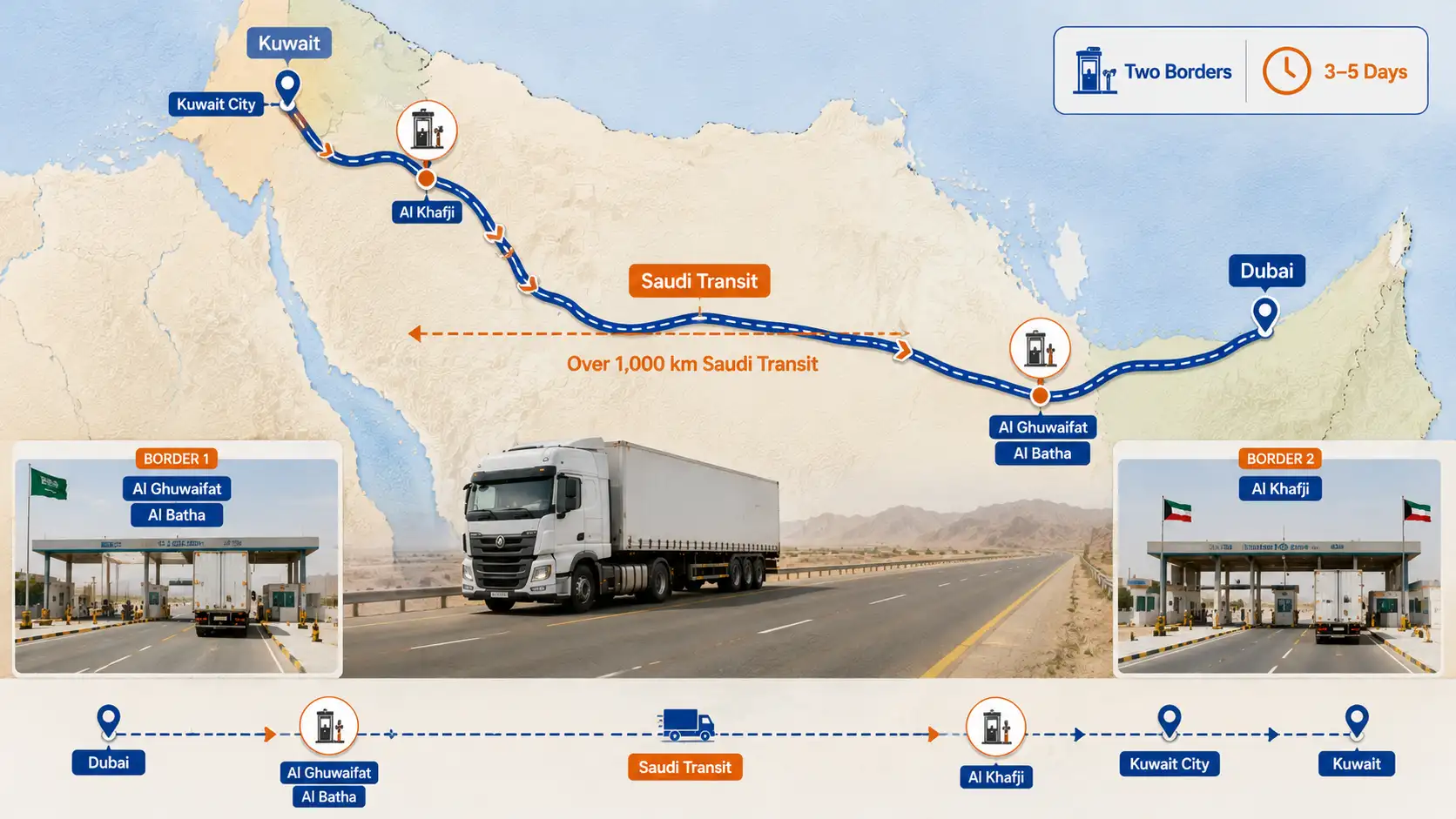
Al Khafji on the Saudi side, Al Nuwaiseeb on the Kuwait side — the second border on every Dubai–Kuwait shipment, reached after your cargo has already crossed Al Ghuwaifat/Al Batha. See our guide to the new digital customs link at this crossing for what changed here in 2026 and covered the length of Saudi Arabia’s Eastern Province.
Quick Facts
- Role: second border on the Dubai–Kuwait route (Saudi exit / Kuwait entry)
- Route: Highway 95, which runs the full 646km from the Al Batha border with the UAE to the Kuwait border, passing Dammam, Khobar, Qatif, and Jubail
- Typical wait: 30 minutes on a quiet weekday, up to 4 hours for trucks during Thursday/Friday evenings or holiday periods
The Busiest Crossing Between the Two Countries
Al Khafji/Al Nuwaiseeb is the primary truck route between Saudi Arabia and Kuwait, and it moves genuine volume — over 10,000 trucks crossed in a single 25-day stretch in early 2026. That volume is exactly why timing matters here more than on most of our other crossings: a Tuesday morning crossing and a Thursday evening crossing at the same border can differ by hours, not minutes. When Khafji is backed up, Al-Raq’e, further west near Hafar Al-Batin, is the fallback — a longer detour but a noticeably lighter queue.
The Alternative: Al-Raq’e
Al-Raq’e sits roughly 120km further from Kuwait City than Khafji, which makes it a genuine detour rather than a like-for-like swap. We don’t default to it, but it’s a real option worth knowing about if your shipment absolutely needs to move and Khafji is running several hours deep.
A Real Cost Change on This Route in 2026
Saudi Arabia rolled out a package of transit reforms in early 2026 that specifically affects cargo like ours moving through the Kingdom to Kuwait. The bank guarantee previously required for transshipment cargo — a financial instrument covering hypothetical Saudi import duties on goods that are only transiting, not staying — has been dropped. For high-value shipments, that guarantee used to add roughly 1.5–3% to the all-in cost. Removing it is a genuine, measurable saving for exactly the kind of bonded transit cargo that makes up every Dubai–Kuwait shipment we run.
Separately, TIR Carnet movement between Saudi Arabia and Kuwait has gone from a pilot programme to a routine option. A TIR-sealed truck moves through Saudi territory without the cargo being cross-loaded or re-inspected at each stage, cutting down the paperwork and handling that would otherwise happen along the route. Where it applies, we use it — it’s a meaningfully cleaner way to move transit cargo than the older process.
Documents Required for Commercial Cargo
- Transit declaration — filed as bonded transit through Saudi Arabia, not a Saudi import, since the cargo is only passing through
- Commercial invoice and packing list — matching what was declared at Al Ghuwaifat/Al Batha
- GCC Certificate of Origin — for UAE-origin goods to move duty-free into Kuwait under the GCC Customs Union
- Kuwait customs import declaration — filed at Al Nuwaiseeb on entry
Realistic Timing
Combined with the first border and the long Saudi transit leg, the full Dubai–Kuwait City journey typically takes 3 to 5 days. Driver rest-stop requirements over the 1,000+ km Saudi leg account for more of that timeline than the border crossings themselves — see the full Kuwait route guide for the complete breakdown.
Cargo Insurance
Given the distance and the number of handling points on this route, we offer cargo insurance covering transit loss and damage across the full journey. Ask for it explicitly when requesting your quote.
Frequently Asked Questions
How busy does Al Khafji actually get?
Genuinely busy — over 10,000 trucks crossed in a 25-day window in early 2026. Wait times swing from 30 minutes on a quiet weekday to up to 4 hours for trucks during Thursday/Friday evenings and holiday periods.
Did the bank guarantee requirement for transit cargo actually change?
Yes — Saudi Arabia dropped the bank guarantee requirement for transshipment cargo in early 2026, removing a cost that previously added roughly 1.5–3% to the all-in price for high-value transit shipments.
What is TIR Carnet and does it apply to my shipment?
It’s a customs transit system that lets a sealed truck move through Saudi Arabia without cross-loading or repeated inspection. It’s now a routine option on the Saudi–Kuwait route, and we use it where it applies to cut down handling along the way.
Is there an alternative if Al Khafji is badly backed up?
Al-Raq’e, near Hafar Al-Batin, is roughly 120km further from Kuwait City but typically carries a much lighter queue — a real option when Khafji is running several hours deep.