
Share truck space on a scheduled departure and pay only for the space you use. The cost-effective option when your shipment doesn’t fill a trailer.
- Quote within the hour
- In-house customs
- No hidden charges
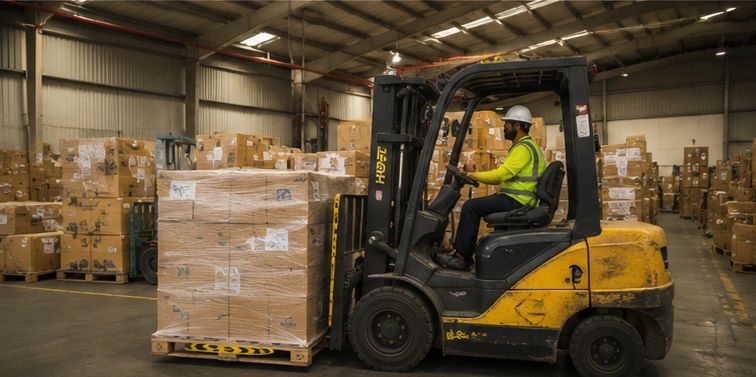
LTL means your cargo shares a truck with other shippers’ consignments, consolidated onto a scheduled departure instead of dispatched the moment it’s ready. You pay for the space you use, not the trailer you don’t fill. This is exactly why LTL tends to be the best logistics option for small businesses in Dubai shipping to the GCC — you’re not paying for capacity you don’t need.
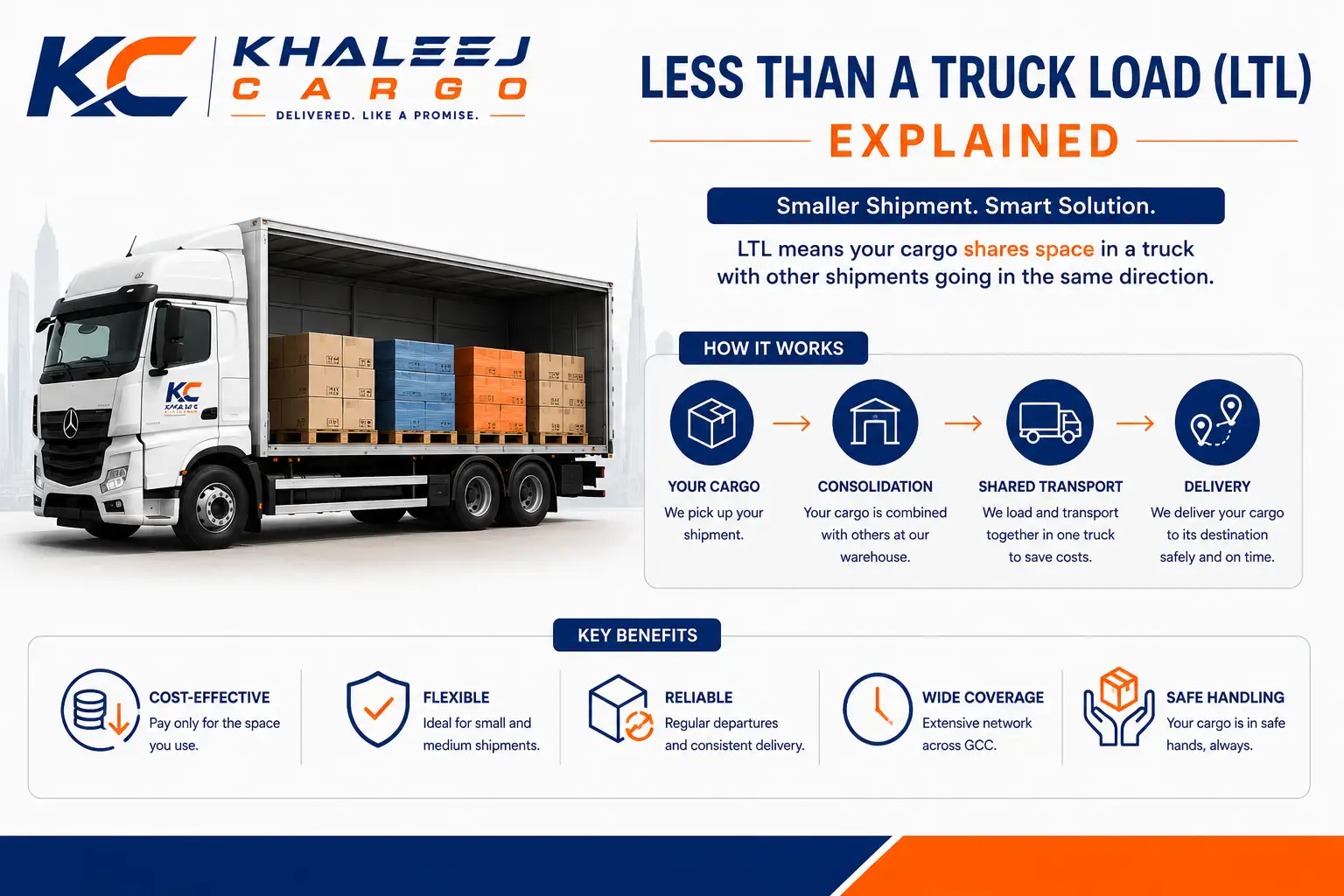
The Real Trade-Off
LTL costs less per kilogram than a dedicated FTL truck, and that’s the whole appeal for shipments that don’t come close to filling a trailer. What you give up is control over the exact departure moment — your consignment waits for a consolidation window, not an instant dispatch. That window is genuinely route-dependent, and quoting a single fixed number for every destination would be misleading. We confirm the real cutoff for your specific route when you book.
Worth knowing before you assume LTL is the cheaper choice: pricing here is based on whichever is higher, actual weight or volumetric weight — the space your cargo takes up, not just what it weighs on a scale. A small, dense shipment stays genuinely cheap. A bulky, lightweight one can rack up volumetric weight fast enough that a dedicated FTL truck ends up costing about the same, or less. If your load is bulky rather than heavy, it is worth running that number before booking.
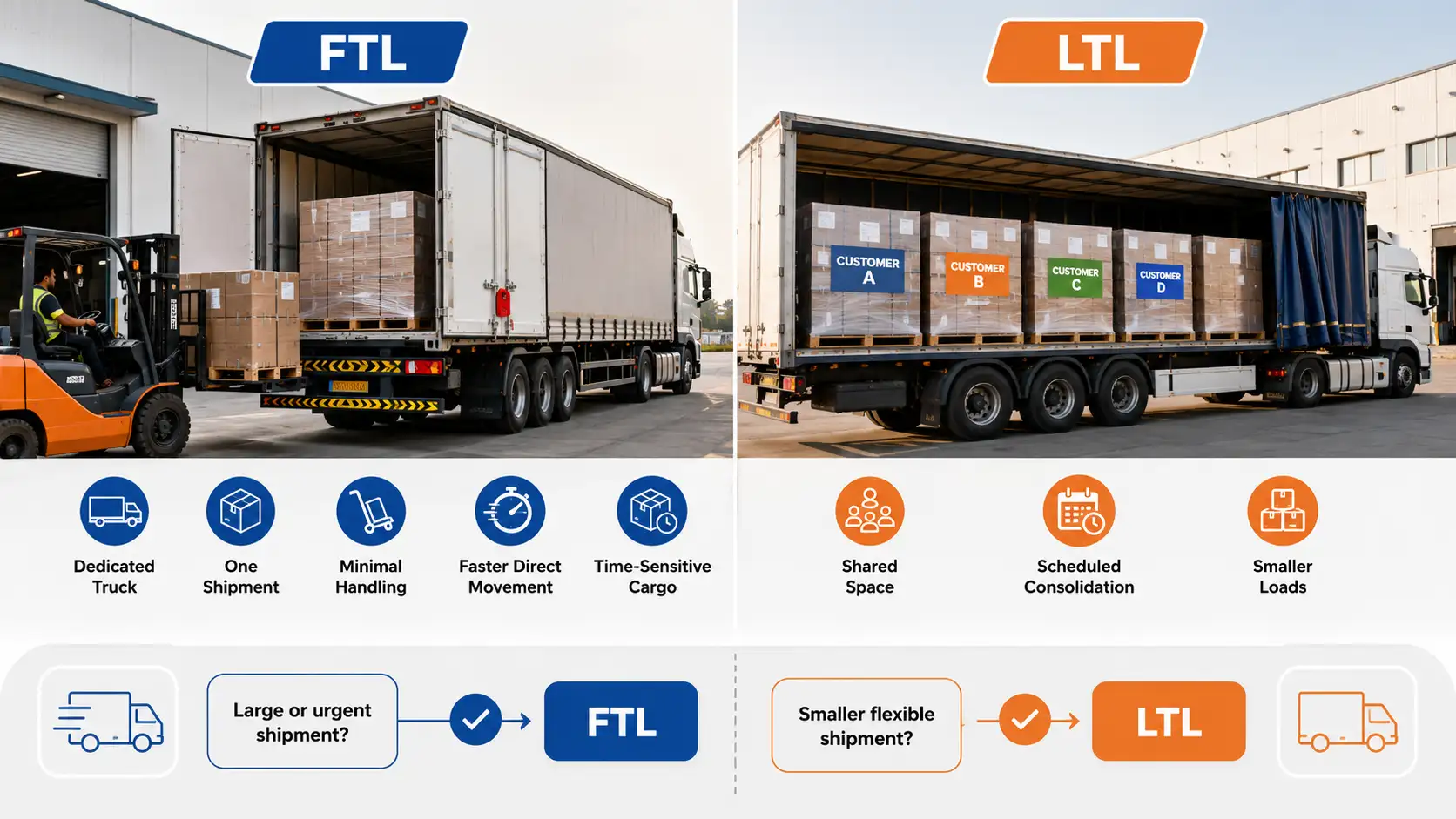
| FTL | LTL | |
|---|---|---|
| Departure | Fixed time once documents confirmed | Scheduled consolidation window |
| Cost | Higher per shipment, no shared costs | Lower per kilogram, shared trailer |
| Handling | Sealed at pickup, opened at delivery | Multiple stops, more handling |
| Best for | Near-full trailer loads, high-value cargo | Smaller shipments, palletized stock |
Why Some LTL Shipments Take Longer Than Expected
Two things extend an LTL timeline beyond the base transit estimate, and neither is really about the driving: special handling requirements — a delivery that needs a lift-gate, or a drop-off at a location outside a carrier’s standard delivery zone — and appointment-based receiving, where the destination warehouse only accepts deliveries at scheduled slots rather than on arrival. Ask us upfront if either applies to your delivery point, since it changes the honest timeline we give you.
One of our LTL consignments to Jeddah once sat an extra day for a reason that had nothing to do with the road — the receiving warehouse only accepted deliveries between 8 and 11am, and the truck arrived at noon. The transit itself was on schedule. The appointment window was the actual constraint, and it’s exactly the kind of detail we now ask about at booking rather than discovering at the gate.
Border-side delays are a separate factor worth planning around too — see our border delay guide for what typically slows a Saudi crossing.
What Typically Moves as LTL
Palletized general cargo is the most common fit — retail stock, spare parts, and standard commercial goods that don’t need a full trailer to justify the trip. It’s also usually the most predictable of everything we haul, which makes it a natural fit for recurring shipments to any of our five GCC destinations.
| Route | Typical consolidation window | Border crossings involved |
|---|---|---|
| Saudi Arabia | Shortest wait — highest shipment volume on this lane | One — direct entry |
| Qatar | Longer — lower shipment volume, less frequent consolidation | Two — Saudi transit, then Qatar entry |
| Oman | Short — frequent departures on this lane | One — direct UAE–Oman border |
| Kuwait | Longer — consolidation depends on volume for the longer haul | Two — Saudi transit, then Kuwait entry |
| Bahrain | Longer — lower shipment volume on this lane | Two — Saudi transit, then the causeway |
Consolidation windows shift with current freight volume on each lane — we confirm the actual cutoff for your route at booking.
Pickup Across Dubai
LTL consolidations pick up from across the city — Deira, Al Qusais, and Ras Al Khor are common origin points for the smaller consignments that make up a typical LTL load, alongside the same Al Quoz and Jebel Ali zones we collect from for full truckloads. Give us your Makani number and we’ll slot your pickup into the right departure window.
Cargo Insurance
Consolidated cargo passes through more hands than a sealed FTL truck, so insurance is worth asking about specifically for LTL shipments. We’ll quote it separately and explain what it covers before you book, rather than leaving it as a line you find out about later.
Not sure how your quote was calculated? See how road freight pricing actually works, including a worked volumetric weight example.
What Sharing a Truck Actually Means at the Border
An LTL shipment carries multiple shippers’ cargo on one sealed truck, each with its own documentation, crossing the same border together. That does not make LTL unreliable — we run it daily — but it does mean the accuracy of your specific paperwork matters just as much within a consolidated load as it would on a truck of your own. If your cargo has anything unusual about its documentation, flag it at booking rather than assuming it is handled identically to a dedicated FTL load.
Frequently Asked Questions
How long is the consolidation window before departure?
It varies by route and current freight volume on that lane — we will give you the actual cutoff at booking rather than a generic estimate that may not hold.
Does LTL cost more on routes that cross two borders?
Transit routes like Qatar, Kuwait, and Bahrain involve extra transit documentation, which is factored into the price — ask for a route-specific quote rather than assuming a flat rate across the board.
Not sure if your shipment needs a full truck or just a share of one? Tell us the details and we’ll say honestly which makes sense, or see everything else we run.