
The same three core documents show up on every route we run, with a few additions depending on where your shipment is headed. This page pulls that together in one place, since we mention pieces of it separately across all five route pages. Whether you’re new to Dubai import & export cargo or you’ve been running GCC routes for years, the documents that actually matter rarely change.
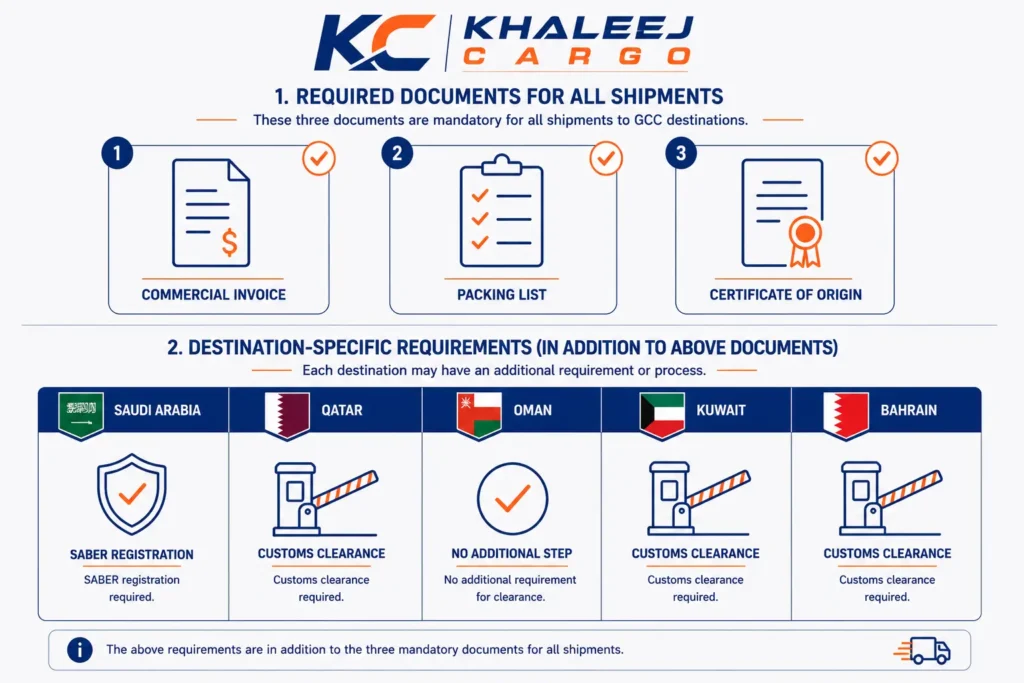
Every Shipment Needs These Three
Whether you’re pulling together the documentation needed for exporting general cargo from the UAE for the first time or the fiftieth, these three don’t change:
The three core documents every outbound GCC shipment from Dubai needs, regardless of destination.
☑ Commercial invoice
Accurate value, description, and correct HS code for every line item. This is the document most likely to cause a delay if it does not match your packing list exactly.
☑ Packing list
Matching the invoice in item count and weight, line for line. The single most common cause of border delay is not a missing document; it is a packing list and invoice that do not quite agree with each other.
☑ GCC Certificate of Origin
Required for UAE-origin goods to move duty-free under the GCC Customs Union — see our Certificate of Origin guide for the full process. Without it, standard import duty applies at the destination even if your goods genuinely qualify.
What Gets Added, Route by Route
| Route | Additional documentation |
|---|---|
| Saudi Arabia | SABER/SASO registration for regulated product categories |
| Qatar | Transit declaration (Saudi leg) + Qatar customs import documentation |
| Oman | None beyond the core three — the simplest route from a documentation standpoint |
| Kuwait | Transit declaration (Saudi leg) + Kuwait customs import documentation |
| Bahrain | Transit declaration (Saudi leg) + Bahrain NPRA import documentation |
What Does Customs Clearance Actually Cost?
There’s no single flat fee for customs clearance services in Dubai — the real cost depends on your route, cargo type, and how much documentation work is involved, and anyone quoting one universal number upfront is simplifying more than they should. What’s predictable is the underlying duty: most GCC destinations apply standard import duty on goods that don’t qualify for GCC-origin exemption, with VAT added on top and varying by country (Saudi Arabia’s is notably higher than the UAE’s). We break down clearance and duty as separate line items on every quote, so you can see what’s a service fee and what’s a government charge — not one number that hides the difference.
Personal Effects Is a Different Checklist Entirely
If you are shipping household goods rather than commercial cargo, the documentation changes: an itemized packing list, a copy of your passport and destination residence visa, and in some cases a No Objection Certificate from your sponsor or employer. Whether your goods qualify as duty-free depends on the used-versus-new distinction covered on our personal effects page.
This Checklist Covers Outbound Shipments
Everything above applies to cargo leaving Dubai for the GCC. If you’re researching customs regulations for cargo import into Dubai or the wider UAE, those rules run differently and aren’t what this page covers — this checklist is built around the export side, which is what we handle.
HS Codes Need to Be Exact, Not Generic
The GCC now runs on a standardized 12-digit Integrated Customs Tariff system, and it requires precise product classification — not a general description. Line items listed simply as “parts” or “accessories” are a common trigger for a document hold, even when everything else on the shipment is in order. If your cargo has any ambiguity in classification, confirm the exact 12-digit code before booking rather than after a hold at the border.
The One Thing That Actually Causes Delays
It is worth repeating, because it is genuinely the most common issue we see: a complete set of documents that do not match each other line for line causes more delays than a missing document does. We check this consistency before your truck leaves Dubai, specifically because it is far cheaper to fix at the warehouse than at a border with a truck already queued.
A typical example: a packing list shows 48 cartons, the commercial invoice shows 47 — someone added a carton to the shipment after the invoice was drawn up and forgot to update it. On paper that is a one-carton discrepancy; at a border crossing it is a hold until someone can explain why the numbers do not match.
“Ninety percent of the document problems we see aren’t missing paperwork — they’re a quantity on the packing list that doesn’t match the invoice by one carton, or a company name spelled two different ways across three documents. We now run every new client’s first shipment through a manual cross-check before it leaves the yard, because that one pass catches almost everything.”
Frequently Asked Questions
Do I need SABER registration for every shipment to Saudi Arabia?
Only for regulated product categories under Saudi Arabia’s SASO conformity program — over 100 categories are covered. Check with us at booking if you are unsure whether your goods qualify.
What is a transit declaration and when do I need one?
It is the document that lets your cargo pass through Saudi Arabia as bonded transit rather than a Saudi import — required on any shipment to Qatar, Kuwait, or Bahrain, since all three routes cross Saudi territory first.
Why does my documentation get rejected even when everything is technically present?
Usually because something does not match — a weight on the packing list that differs from the invoice, or an HS code that does not match the physical goods. Completeness and consistency are two different things, and consistency is what actually gets checked.
Getting the paperwork right doesn’t help if the goods themselves are not allowed in — see our Prohibited & Restricted Items guide before you book, especially for anything unusual.
Ask us to check your documentation before you ship → | See all insurance & customs guides →