
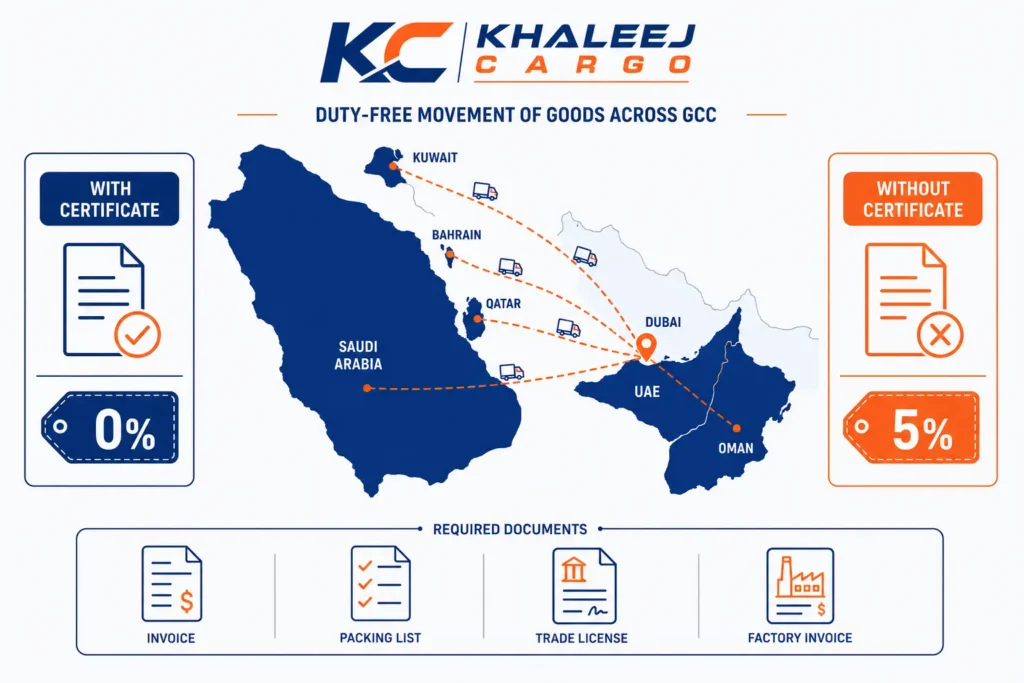
The GCC Customs Union is the reason UAE-origin goods can move to Saudi Arabia, Qatar, Oman, Kuwait, and Bahrain without paying import duty — provided one specific document is in order. We mention this on every single route page on this site. Here is what it actually means and how to get that document right.
What the GCC Customs Union Actually Does
The six GCC states — the UAE, Saudi Arabia, Qatar, Oman, Kuwait, and Bahrain — operate a customs union that allows goods originating within the bloc to move between member states without the import duty that would otherwise apply. Without it, most non-GCC goods entering these countries face a standard 5% duty on the CIF (Cost, Insurance, Freight) value. The customs union removes that duty for genuinely GCC-origin goods — but only if you can prove origin, which is exactly what a Certificate of Origin does.
Who Actually Issues the Certificate of Origin
In Dubai, Dubai Chambers (formerly the Dubai Chamber of Commerce and Industry) is the body that issues Certificates of Origin for mainland-registered exporters. If your company is registered in a free zone — JAFZA, DAFZA, Hamriyah, and similar — the certificate comes directly from that free zone authority instead, not Dubai Chambers. Getting this wrong (applying to the wrong body for your registration type) is a common, entirely avoidable delay.
What You Need to Apply
- Commercial invoice — must match your packing list and shipment exactly
- Packing list
- Valid trade license
- Manufacturer’s invoice or factory license — required if you are the manufacturer, or shipping goods you did not produce yourself
Applications go through the Dubai Chambers online portal, and approval typically comes within about two hours of submission if your documents are complete and consistent — the same consistency issue that causes most border delays also causes most Certificate of Origin rejections.
What It Actually Costs
The GCC-specific Certificate of Origin fee scales with your invoice value, not a flat rate:
| Invoice Value (AED) | Fee (AED) |
|---|---|
| 1 – 1,000 | 10 |
| 1,001 – 5,000 | 20 |
| 5,001 – 20,000 | 30 |
| 20,001 – 40,000 | 40 |
| 40,001 – 100,000 | 50 |
| 100,001 – 500,000 | 100 |
| Above 500,001 | 200 |
Set against the 5% duty you avoid by having a valid certificate, this fee is close to negligible on most commercial shipments — which is exactly why skipping it rarely makes financial sense.
Why This Matters More on Transit Routes
On our direct routes — Saudi Arabia and Oman — your Certificate of Origin needs to hold up at one border. On our transit routes — Qatar, Kuwait, and Bahrain — it needs to remain consistent across two separate customs authorities, alongside the transit declaration covering the Saudi leg. A certificate that is even slightly inconsistent with your other documents is more likely to cause a problem on a two-border route than a one-border one, simply because there are more checkpoints where the inconsistency can be caught.
Frequently Asked Questions
Do I need a new Certificate of Origin for every shipment?
Yes — it is tied to the specific invoice and shipment, not issued as a standing document you reuse.
What happens if I ship without one?
Your goods lose duty-free treatment and standard import duty (typically 5% of CIF value) applies at the destination, even if the goods are genuinely GCC-origin.
Does my company need to be a manufacturer to get a Certificate of Origin?
No — traders and re-exporters can apply too, but need to provide the manufacturer’s invoice or equivalent documentation alongside their own trade license.
How long does approval take?
Typically around two hours through the Dubai Chambers portal if your documents are complete and consistent. Incomplete or inconsistent submissions take longer.
Ask us about documentation for your shipment → | See all 5 GCC routes →