
Your cargo weighed 180kg on the scale, but your quote is priced as if it weighed 340kg — and no, nobody made a mistake. This is the single most common source of confusion on GCC road freight quotes, and it happens because weight is only half of what a truck actually runs out of. The other half is space, and once you understand how carriers charge for space, a quote that looked wrong at first glance usually turns out to be exactly right.
Weight Isn’t What You’re Really Paying For — Space Is
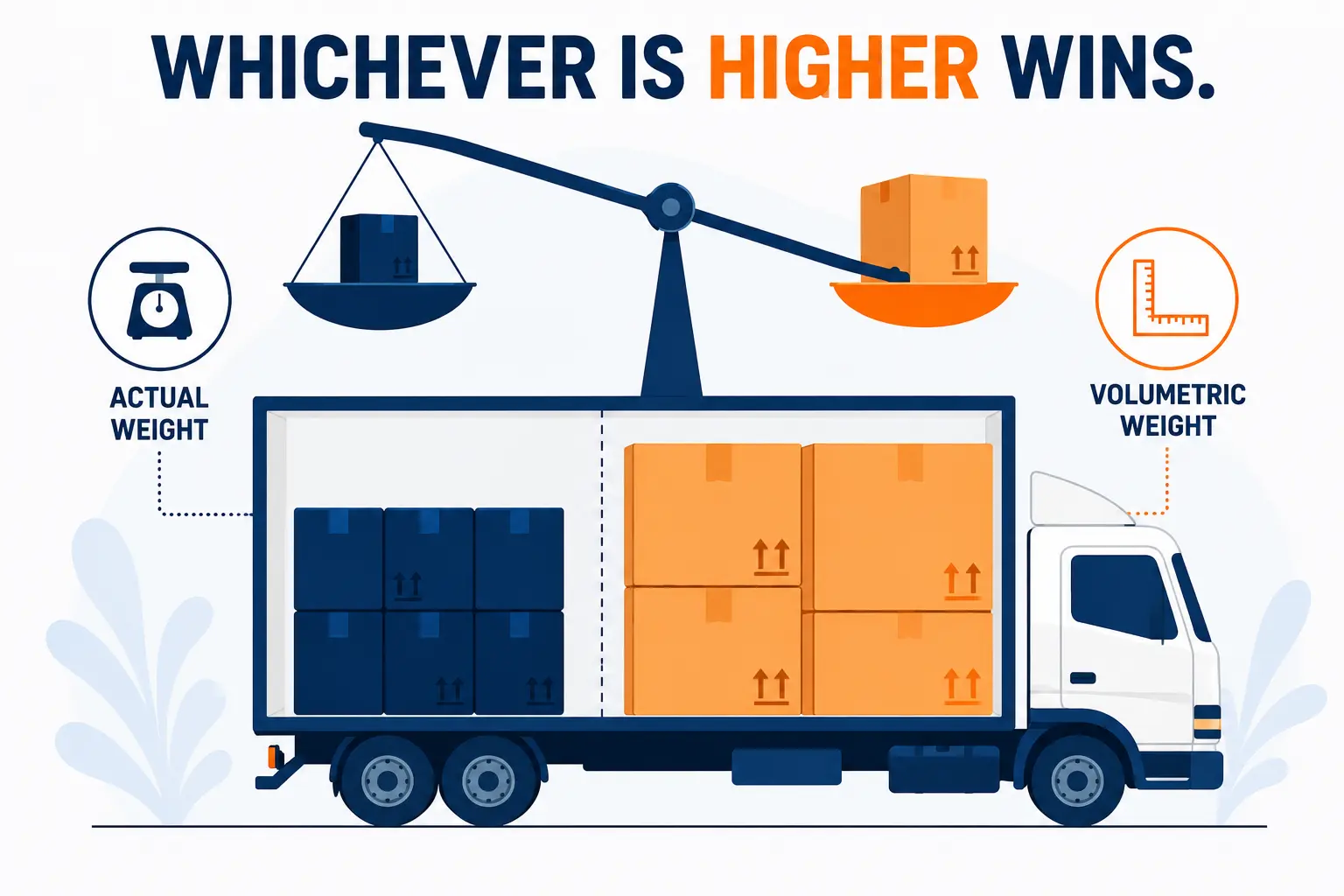
A truck has two limits: how much it can carry, and how much room it has. For dense cargo — machinery, palletized tiles, boxed spare parts — weight is usually the limiting factor, and actual scale weight is what gets billed. But for bulky, lightweight cargo — foam packaging, furniture, empty containers, insulation material — the truck runs out of floor space long before it runs out of carrying capacity. If carriers only billed by scale weight, a trailer full of cushions would occupy an entire truck while paying for a fraction of it. Volumetric weight (also called dimensional or DIM weight) exists to close that gap: it converts the space your cargo occupies into an equivalent weight figure, and you’re billed on whichever number is higher — actual weight or volumetric weight. That’s the whole mechanism, and once you see it, quotes that looked confusing usually make complete sense.
How the Calculation Actually Works
Volumetric weight is calculated from your shipment’s dimensions, converted through a divisor that turns cubic space into an equivalent kilogram figure. The formula looks like this:
(Length × Width × Height, in centimetres) ÷ divisor = volumetric weight in kg
Here’s the part most pricing guides skip: the divisor for road freight isn’t one fixed industry number. Air freight has a genuinely standardised divisor — 6,000, set by the International Air Transport Association (IATA), but road freight divisors vary by carrier and region — commonly somewhere between 3,000 and 5,000 for the cm³ version of the formula, which works out to roughly 200–333kg treated as the weight of each cubic metre of space. If a pricing page tells you road freight always uses exactly one number, that’s a simplification, not a fact — ask your carrier which divisor applies to your shipment before you assume a number.
Volumetric Weight Divisors by Freight Mode
| Mode | Typical Divisor | Set By |
|---|---|---|
| Air freight | 6,000 (fixed) | IATA industry standard |
| Road freight | 3,000–5,000 (varies) | Individual carrier |
| Sea freight (LCL) | Not divisor-based | Priced per CBM or per tonne, whichever is greater |
Road freight is the one mode without a single fixed number — which is exactly why asking your specific carrier matters more here than it does for air freight.
A Worked Example
Say you’re shipping 6 boxes of retail stock to Riyadh, each box measuring 60cm × 50cm × 70cm, with a combined actual weight of 180kg.
- Step 1 — volume per box: 60 × 50 × 70 = 210,000 cm³
- Step 2 — total volume: 210,000 × 6 boxes = 1,260,000 cm³
- Step 3 — volumetric weight (using a 4,000 divisor as an illustrative mid-range figure): 1,260,000 ÷ 4,000 = 315kg
- Step 4 — compare: actual weight 180kg vs. volumetric weight 315kg — the higher figure, 315kg, is what gets billed.
That’s a real 75% gap between what the scale says and what the invoice says, purely because the boxes are bulky relative to their weight. Nothing about that is a hidden fee — it is the same mechanism every road carrier in the region uses, just rarely explained with an actual number attached.
The Part That Actually Changes Your Decision: FTL vs. LTL
This is the genuinely useful bit that most pricing explainers never get to. Volumetric weight only matters if you’re paying for shared space — which is exactly what LTL (less-than-truckload) is. On an FTL (full truckload) booking, you’re paying for the entire trailer regardless of how much of it your cargo actually fills — so volumetric weight becomes irrelevant to your price the moment you’ve booked the whole truck.
That creates a genuine crossover point worth knowing about: if your volumetric weight is climbing close to what a full trailer would cost anyway, LTL stops being the cheaper option. A shipment of bulky, lightweight cargo that looks small on the scale can sometimes cost more under LTL’s volumetric pricing than it would to simply book FTL and stop measuring cubic centimetres altogether. This is exactly the kind of thing worth asking about directly when you request a quote — a straight answer to “would FTL actually be cheaper for this load” tells you more than comparing two numbers on a page.
Practical Ways to Reduce Volumetric Weight
- Flat-pack where possible. Furniture and fixtures that can be disassembled take up dramatically less volume than pre-assembled pieces — see our furniture shipping guide for how this plays out with wood packaging rules specifically.
- Right-size the box, not the product. A box with several centimetres of empty air on every side inflates volumetric weight for no benefit — the calculation uses the outer dimensions of the box, not the item inside it.
- Consolidate small boxes into fewer, denser ones. Multiple half-empty boxes cost more under this formula than the same goods packed into one properly filled one.
- Ask which divisor applies before you book, especially for a genuinely bulky, lightweight load — it’s the one number that changes the entire calculation, and it’s worth confirming rather than assuming.
What to Actually Ask For in a Quote
A quote that just states a final number tells you nothing about whether you’re being billed on actual or volumetric weight, or what divisor was used to get there. Ask for the breakdown: actual weight, calculated volumetric weight, the divisor applied, and which of the two the price is based on. That’s not a difficult request, and a carrier who answers it clearly and immediately is telling you something real about how they operate — see our guide to choosing a road freight company for more on what else is worth asking before you book.
Frequently Asked Questions
What is volumetric weight in road freight?
A weight figure calculated from your shipment’s dimensions rather than its actual scale weight, used to account for the space bulky, lightweight cargo occupies on a truck. You are billed on whichever is higher — actual weight or volumetric weight.
What divisor is used to calculate volumetric weight for road freight?
Unlike air freight, which uses a single IATA-standard divisor of 6,000, road freight divisors vary by carrier, commonly falling somewhere between 3,000 and 5,000 for the centimetre-based formula. Always confirm the specific divisor with your carrier rather than assuming one figure applies universally.
Does volumetric weight apply to full truckload (FTL) shipments?
No, not to your price. On FTL, you are paying for the entire trailer regardless of how much of it your cargo fills, so the volumetric calculation that matters for LTL pricing does not change what an FTL booking costs.
How can I reduce my shipment’s volumetric weight?
Flat-pack items where possible, use boxes sized close to the actual product rather than leaving excess empty space, and consolidate multiple small boxes into fewer, denser ones. All three reduce the cubic space your shipment occupies without changing its actual weight.
Why did my quote come in higher than I expected based on the weight I gave?
This is almost always volumetric weight at work — your cargo’s dimensions produced a higher billable figure than its actual weight. Ask your carrier for the specific calculation (dimensions, divisor used, and resulting volumetric weight) so you can see exactly where the number came from.