
The GCC Customs Union makes people assume there’s one tax rate across all five countries you’re shipping to — there isn’t, and confusing duty with VAT is exactly where that assumption breaks down. Import duty really is harmonised across the GCC. VAT is not. Knowing which is which changes how you estimate a landed cost, and almost nobody explains this distinction clearly for cargo shippers specifically.
The Duty Is (Mostly) the Same Everywhere
Because the GCC operates as a customs union, all six member states — including the UAE — apply a shared Common External Tariff on goods entering from outside the GCC: a standard 5% duty on CIF value (cost, insurance, and freight combined) for most general cargo categories. This is the figure we’ve covered before on our Saudi customs clearance guide and it holds regardless of which of our five destinations your shipment is heading to. Goods that qualify for duty-free movement under a valid GCC Certificate of Origin skip this duty entirely — that part of the system genuinely is uniform.
What’s not uniform is what happens after duty: VAT. And that’s where five destinations stop looking like one bloc.
VAT Is Where the Real Differences Are
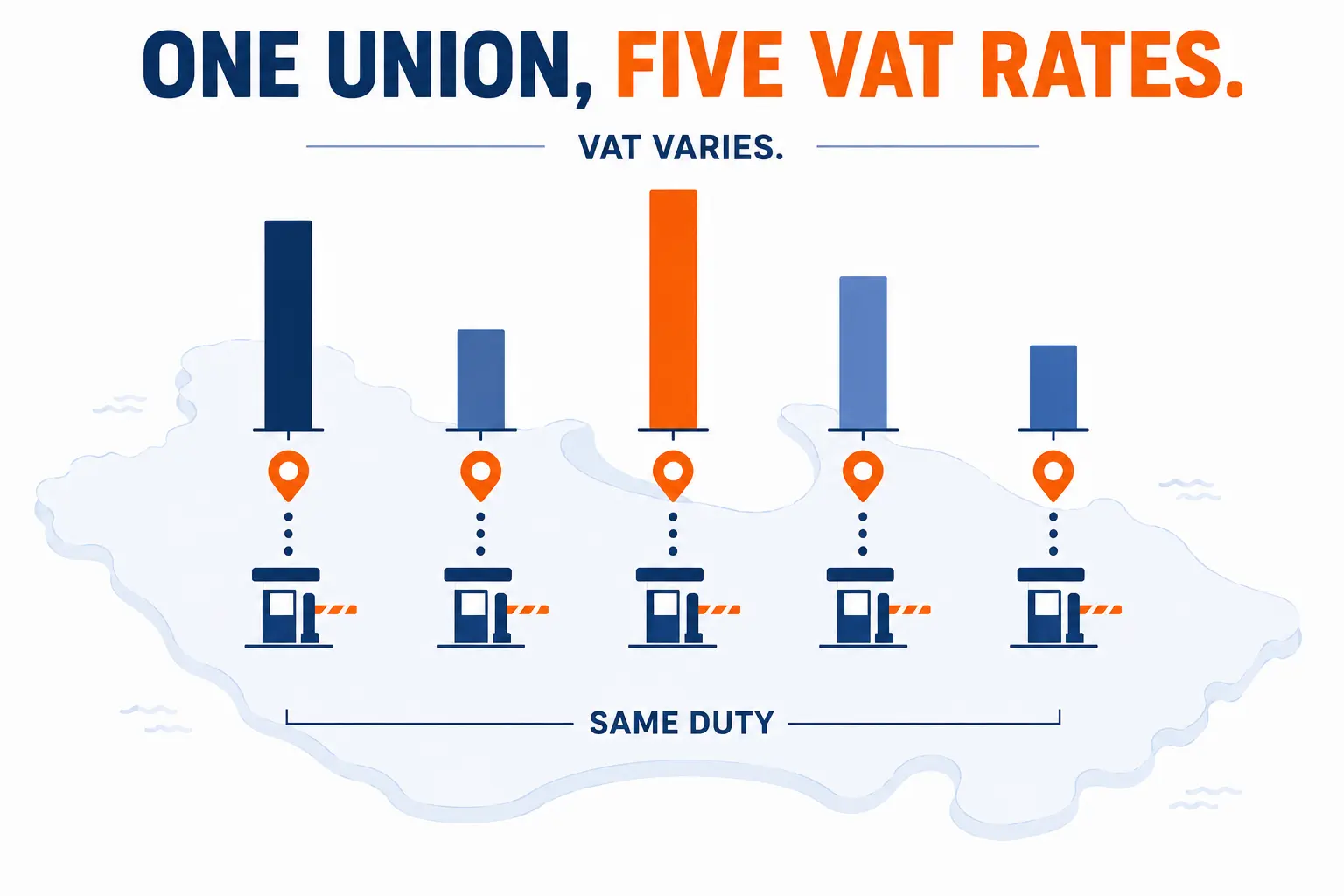
Each GCC state sets its own VAT rate independently under the GCC Unified VAT Agreement, which only set a 5% minimum floor — not a fixed shared rate. Here’s where the five countries you can book with us actually stand:
| Country | Standard VAT Rate | Introduced | Authority |
|---|---|---|---|
| Saudi Arabia | 15% | 2018 (5%), raised to 15% in July 2020 | ZATCA |
| Bahrain | 10% | 2019 (5%), raised to 10% in January 2022 | NBR |
| Oman | 5% | April 2021 | Oman Tax Authority |
| Qatar | Not yet implemented | Not yet enacted | General Tax Authority |
| Kuwait | Not yet implemented | Repeatedly delayed | Not yet established |
Saudi Arabia’s rate is genuinely the outlier here — three times Oman’s, and one and a half times Bahrain’s. If you’re comparing landed cost across destinations for planning purposes, VAT is the number that actually moves, not duty.
Why Qatar and Kuwait Are Different
Qatar and Kuwait have both signed the GCC Unified VAT Agreement but haven’t enacted the domestic legislation to actually charge it. Practically, that means cargo landing in either country currently clears without a VAT charge at all — not a 0% rate, but no VAT mechanism in place yet. Kuwait’s delay in particular has dragged on for years over political and economic disagreement, and neither country has announced a confirmed start date as of this writing. Don’t plan around this staying permanent — both are signatories to the same framework Saudi Arabia and Bahrain already used to introduce their own rates.
The 2026 Rule Change That Lets These Gaps Widen Further
In June 2026, Saudi Arabia’s Council of Ministers approved amendments to the GCC Unified VAT Agreement, with other member states expected to follow through their own ratification processes. The changes touch five articles of the Agreement, and the one that matters most for shippers confirms that each GCC state may set its own standard VAT rate under domestic law, rather than working toward one shared rate over time. This wasn’t a new practice — Saudi Arabia and Bahrain had already raised their rates unilaterally years earlier — but it formalises rate divergence as the ongoing model for the region rather than a temporary gap waiting to close.
A Worked Example
Say you’re shipping a pallet of retail goods with a CIF value of AED 10,000, and it doesn’t qualify for GCC-origin duty exemption:
- To Saudi Arabia: 5% duty (AED 500) + 15% VAT calculated on CIF plus duty (15% of AED 10,500 = AED 1,575) = AED 2,075 in total charges
- To Oman: 5% duty (AED 500) + 5% VAT on CIF plus duty (5% of AED 10,500 = AED 525) = AED 1,025 in total charges
- To Qatar (currently): 5% duty (AED 500), no VAT charge = AED 500 in total charges
Same CIF value, same duty rate, and the total charges vary by more than 4x purely because of VAT. That’s the number worth modelling before you assume a landed cost, not the duty.
What This Means When You’re Planning a Shipment
If you’re comparing costs across our five destinations, or budgeting for a customer who’s asking why a Saudi-bound order costs more to land than an identical one going to Qatar, VAT is almost always the answer — not our freight rate, not the duty, and not the distance. We flag which VAT regime applies at quote stage specifically because this catches first-time GCC shippers more than any other cost factor. See our documentation checklist for what’s needed to support a duty-exemption claim, or get a quote with the VAT position for your specific destination included upfront.
Frequently Asked Questions
Is customs duty the same across all GCC countries?
Yes, for the most part. As a customs union, the GCC applies a shared 5% Common External Tariff on CIF value for goods from outside the bloc, regardless of which member state they’re entering. Goods with a valid GCC Certificate of Origin can qualify for duty exemption.
Is VAT the same across all GCC countries?
No. Each country sets its own rate independently: 15% in Saudi Arabia, 10% in Bahrain, 5% in the UAE and Oman, and not yet implemented in Qatar or Kuwait.
Why does Saudi Arabia have a higher VAT rate than the rest of the GCC?
Saudi Arabia raised its VAT rate from 5% to 15% in July 2020 as part of a broader fiscal reform response to economic pressures. It remains the highest standard VAT rate in the GCC.
Does Qatar charge 0% VAT?
No — Qatar hasn’t implemented a VAT system at all yet, which is different from applying a 0% rate. No VAT is currently charged on qualifying imports, but this reflects the absence of legislation, not a permanent zero rate.
Can VAT rates in the GCC change again?
Yes, and 2026 amendments to the GCC Unified VAT Agreement explicitly confirmed that member states can set rates above the 5% floor independently. Rate divergence across the region is expected to continue rather than converge.